


40 Welcome Message Examples for Your Website (Copy and Paste)
40 website welcome message examples for online stores, grouped by situation and industry, ready to copy into a welcome popup.
Learn how to boost your Shopify store's conversion rates with data-driven A/B testing in our step-by-step guide.
In short
Discover the future of Shopify A/B testing in 2026 with this expert guide. Learn how to enhance your Shopify store's conversion rates through data-driven strategies, dynamic content, and AI automation. Explore real-life examples and overcome common challenges to maximize your ecommerce success. Perfect for those looking to optimize their Shopify store performance and boost revenue.
As marketers, we often rely on our instincts when it comes to understanding our audience.
Sure, it's easier and more comfortable to simply trust our gut feelings rather than testing things out.
But unfortunately, hunches can lead to wasted resources on changes that don't yield results or—even worse—harm conversion rates in your Shopify store.
While gut feelings can play a role in generating hypotheses or sparking creativity, they should not replace data-driven methodologies like A/B testing.
With A/B testing, you can get clear answers based on data. This will help you make better decisions and improve your conversion rate optimization efforts.
But how does A/B testing work? And how can you implement it in your Shopify store? We're here to help you out with our step-by-step guide.
Get on board!
In short: A/B testing helps you figure out what works and what doesn't in your Shopify store.
By testing different versions of specific elements in your online store, you can see what makes people buy more.
Once you understand what resonates with your website visitors, you can prioritize those aspects and eliminate what doesn't contribute to sales.
All of this leads to increased conversion rates.
A/B testing is vital for boosting conversion rates, optimizing your Shopify store's performance, and maximizing revenue by pinpointing purchase-triggering elements.
Luckily, there are solutions that can be used to make A/B testing easier, less resource intensive, and more flexible.
One of the easiest places to start is your popups, because you can test them without touching your theme.
Numerous tools are available for this in the Shopify App Store. OptiMonk is one such option: its AI agent builds your popups and helps you A/B test them.
Using OptiMonk, you can add a variant to any popup campaign, for example with a different headline or offer.
Just ask the agent for the variant in plain words. You can also ask it for test ideas and see each idea next to your current popup.
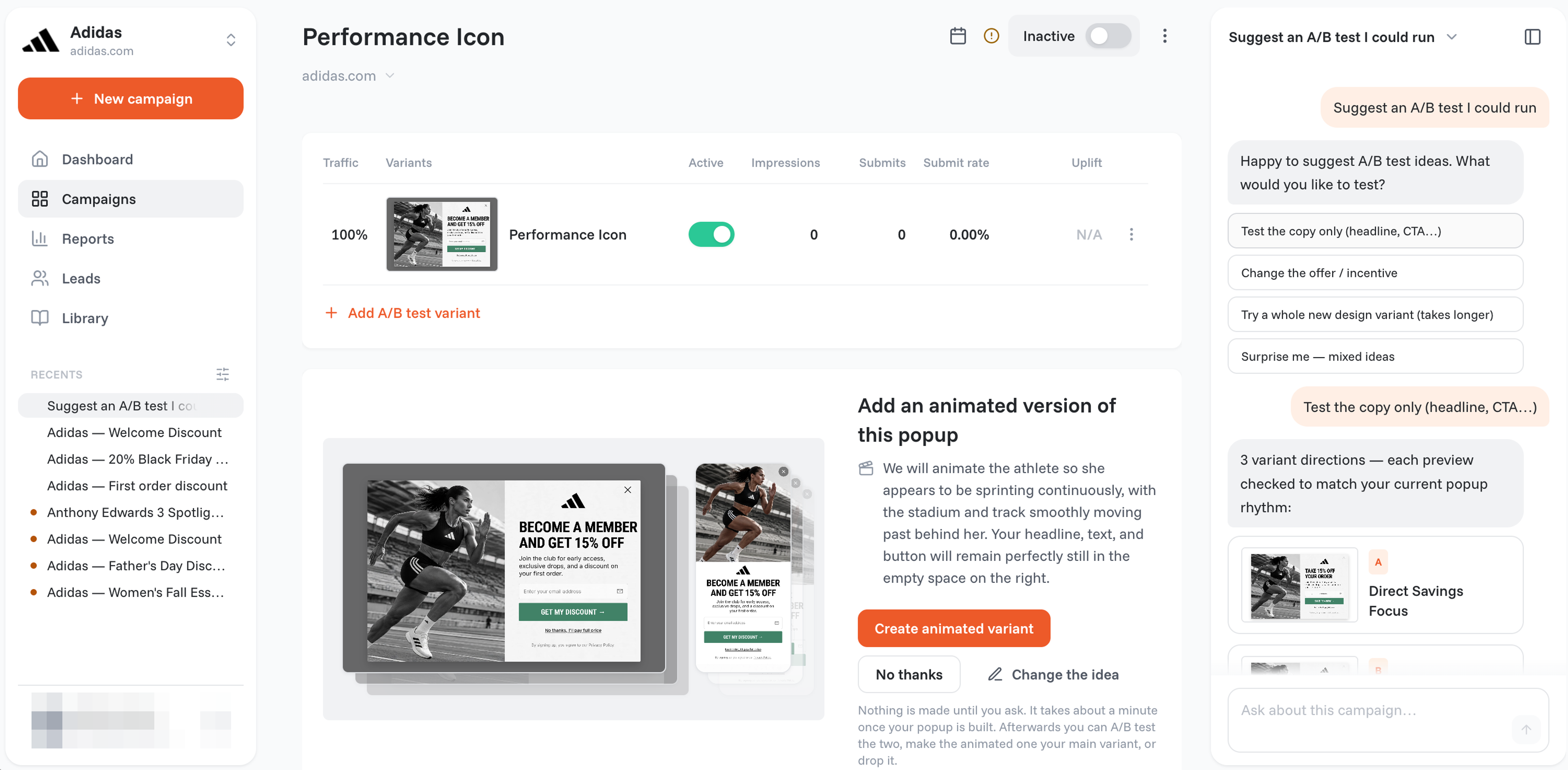
To learn which version works better, (the original or the new one) you'll need to start an A/B test.
Here’s how to set it up:
OptiMonk splits your traffic between the variants. You can also add a Control group that sees no popup at all, so you can measure the popup's real uplift.
OptiMonk shows each variant's uplift and chance to win, and it can declare the winner automatically (by default at a 95% chance to win, after at least 200 conversions and 3 days), then stop the other variants.
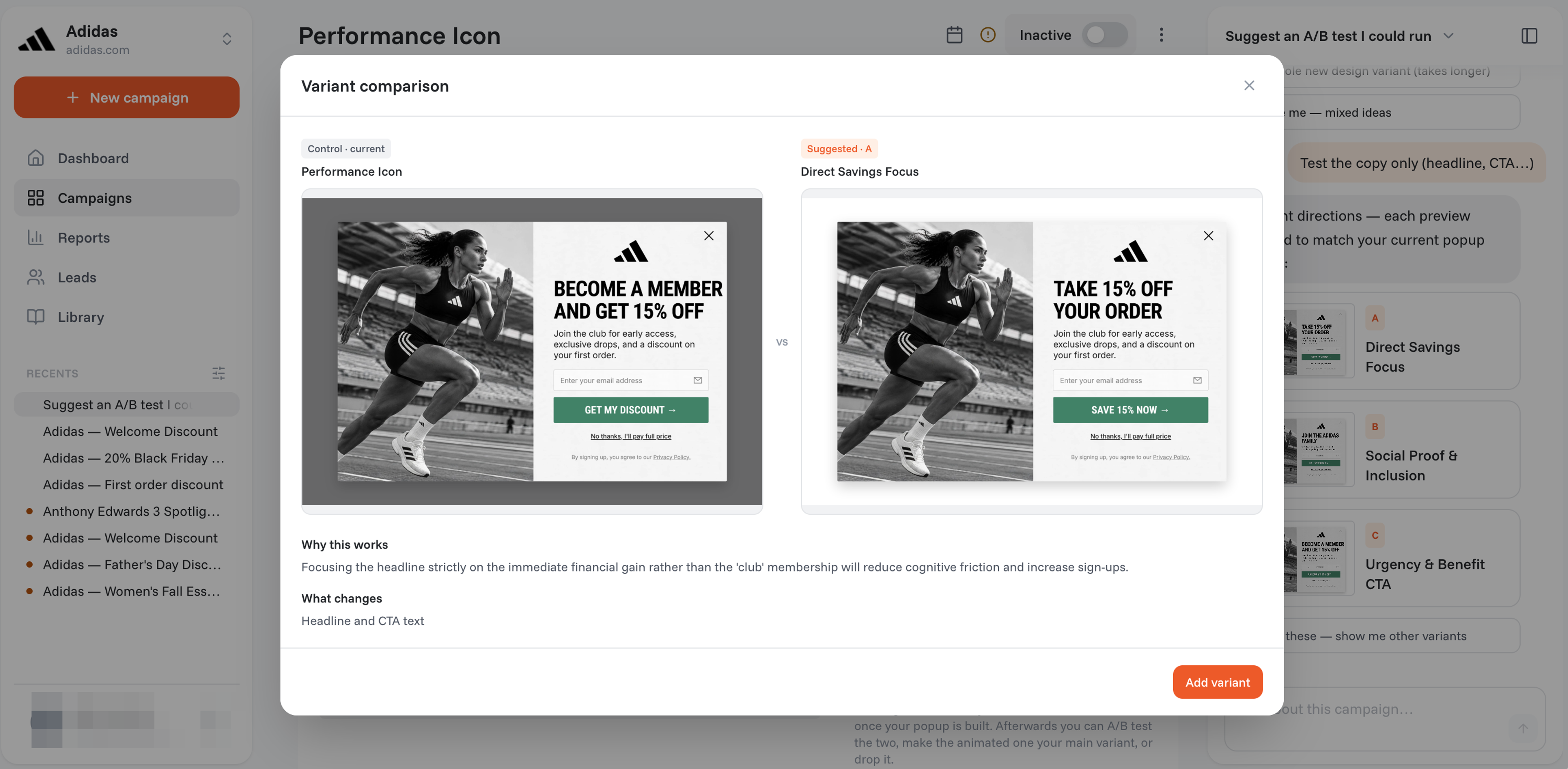
This solution is quick to set up, and because the agent suggests test ideas, you don't have to come up with every test yourself.
Looking for popup ideas to test? Take a look here.
Ready to explore how other Shopify store owners have implemented A/B testing in their stores?
Let's dive in and find out!
Our first example comes from Shopify store Bukvybag, who’d been struggling with low conversion rates on their homepage.
To tackle this problem, they experimented with various value propositions as headlines.
This method helped them make better decisions using data and increase conversions on their homepage.
In fact, they achieved a 45% increase in orders thanks to running A/B tests.

Next up on the list is Hannah & Henry, another Shopify store.
Product detail pages attract a significant portion of an ecommerce website's traffic, but Hanna & Henry struggled to boost conversions on these pages.
They created multiple variations and ran A/B tests on their product pages, testing visual elements to find out which version resonated best with their website visitors.
Check out their control variant page:

Version B included a slogan and a product description:

Version C added a review, a slogan, and a product description:

And Version D featured a review along with a slogan:

Next, let's talk about Goldelucks, an Australian-based dessert company.
This Shopify store implemented a highlighted element on their product pages using dynamic content. This part was meant to give visitors extra details to simplify the buyer's journey.
They conducted split tests with people visiting their website, which they ran for at least two weeks.
The test results were impressive: they saw a 66.2% increase in revenue, which demonstrates how placing messages in the right spots can really pay off and offer a better customer experience.

Finally, let's check out Obvi's split testing results. They A/B tested adding a countdown timer to their discount popup.
Obvi made two versions of the popup: one had a timer, and the other didn't. They conducted multiple tests on both variations, using a sample size from their target audience.
The version with the timer got more people to buy, with a 7.97% higher conversion rate.
What's the lesson here?
Creating a sense of urgency can lead to more people making purchases. Plus, it proves that something as simple as adding a countdown timer to a popup can boost sales!

We’ve seen the undeniable benefits of A/B testing. However, like any tool or methodology, it comes with its own set of challenges that need to be carefully navigated.
Understanding these challenges is crucial for effective implementation of A/B testing.
A/B testing is not a silver bullet for immediate results. It requires careful planning, execution, and patience.
From designing the experiment to collecting enough data for statistical significance, the process can take a while.
This extended timeframe can be particularly challenging in fast-paced environments where decisions need to be made quickly.
Moreover, rushing through tests or making decisions based on incomplete data can lead to erroneous conclusions.
A/B testing can require a lot of resources to do it right. Beyond the direct costs of tools and technologies, there are indirect costs associated with personnel and time.
For smaller Shopify stores or teams with limited budgets, allocating these resources can be a substantial challenge.
A/B testing involves more than just creating two versions of a page and seeing which one performs better.
It requires some technical know-how and a robust understanding of statistical principles to interpret results correctly.
Most A/B testing tools are designed for simpler UI solutions. With others, you can only A/B test a specific landing page.
This can limit the range of experiments you can run and the insights you can gather.
Despite these challenges, A/B testing can still be incredibly valuable for improving your website or app.
You simply need to keep the potential pitfalls in mind and use the right tools to help you overcome these challenges.
A/B testing is a method used to compare two versions of something—like a webpage, app, or just a few website elements—to gain valuable insights and to determine which one performs better. It involves showing version A to one group of people and version B to another group, then measuring their responses to see which version is more effective.
You can A/B test various elements on your Shopify store, including headlines, product descriptions, call-to-action buttons, images, layout designs, pricing strategies, and checkout processes.
To conduct A/B testing on Shopify, you can use built-in features of Shopify Plus or integrate third-party A/B testing tools like OptiMonk, which are available in the Shopify App Store. These tools typically allow you to create multiple versions of a webpage or element, define your testing parameters, and analyze the results.
Some best practices include clearly defining your goals, testing one element at a time, ensuring your sample size is statistically significant, running tests for an adequate duration, and analyzing the results accurately.
The metrics you’ll want to measure in A/B testing (you can set up goal tracking in Google Analytics or another analytics tool) may vary depending on your specific goals, but common metrics include conversion rate, click-through rate, bounce rate, average order value, and revenue per visitor.
While A/B testing may not be every marketer's favorite thing, it remains one of the most effective ways to make data-driven decisions.
In this detailed guide, our goal was to demonstrate various methods for conducting A/B tests on your Shopify store.
We trust that you've gained valuable insights into Shopify A/B testing and how it can help you succeed on your journey.


40 website welcome message examples for online stores, grouped by situation and industry, ready to copy into a welcome popup.

12 Christmas popup examples for online stores, from welcome offers and spin-to-win wheels to gift quizzes and last-chance countdowns.

In this article, we'll share the best alternatives to Sleeknote that help you to get more leads in 2026.